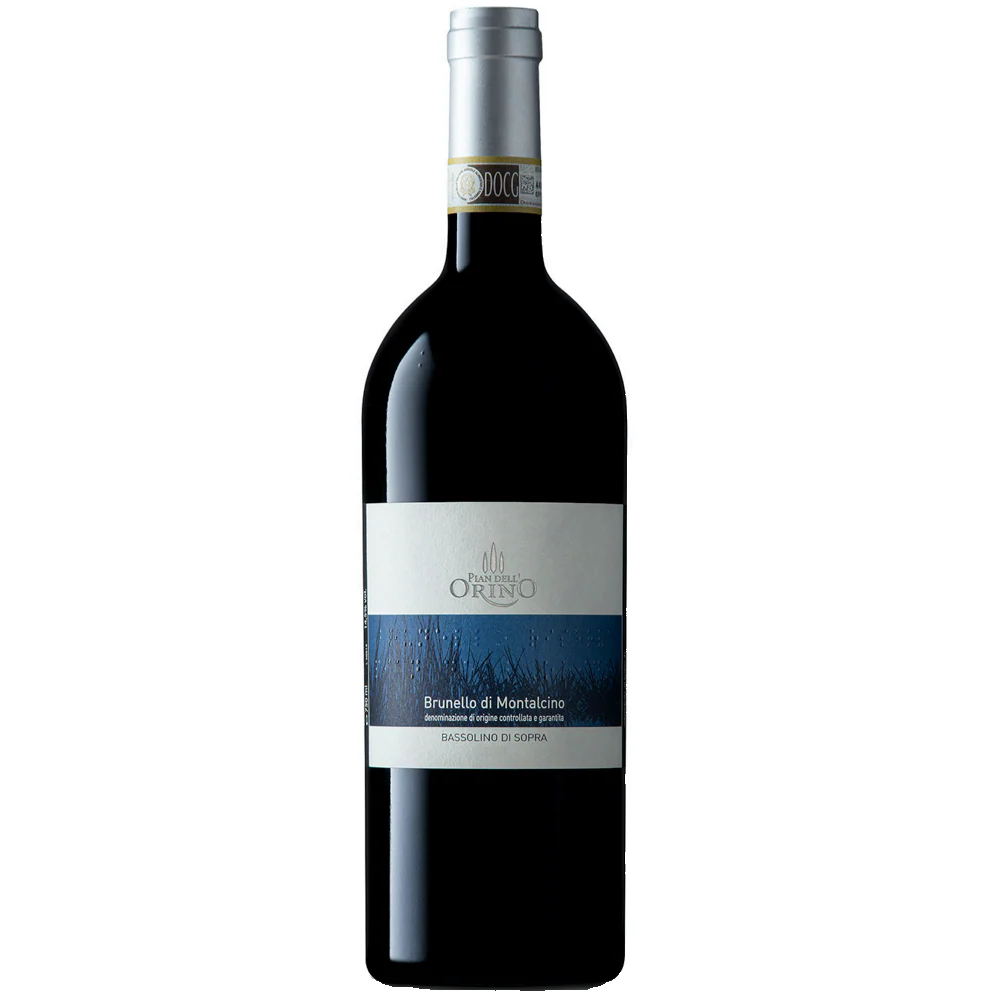
Pian dell'Orino Vigneti del Versante Brunello di Montalcino 2018
Our Tasting Note - 3/14/2026
Open for 7 hours, tasted over the last 4.
The ruby red core shows a tiny bit of garnet at the edges. The nose is pronounced, showing red fruits like black cherry, currants, and raspberry, primary and some tertiary, subtle savory and sweet spices, garden herbs, a touch balsamic and pretty florals. The palate is med+ bodied, med/med+ fine grained and velvety tannins, perfectly integrated acidity, while the deeply expressive palate perfectly expresses the bouquet with a long, elegant and resonant finish.
95+ points Vinous Media
Drinking window: 2024 - 2032
The 2018 Brunello di Montalcino is a fascinating interpretation of Vigneti di Versante. It takes the lifted, floral, exotic nature of the vintage and marries it beautifully to Pian dell'Orino's style of finesse and refinement. Mint leaf, crushed rocks, hints of camphor and dried strawberries are complicated by suggestions of ground ginger in the glass. This is elegant and refined, silky to the core, with tantalizing acidity and mineral tones further enlivened by hints of orange as red plums settle upon the senses. Its tannins are soft and dusty, with an admirable concentration seldom seen in 2018, finishing fresh yet lightly structured. This is simply delectable. This is the first vintage where Pian dell'Orino used an optical sorter, which drastically helped with the selection. In 2018 there will not be a Bassolino di Sopra. All the juice went to the Vigneti del Versante. - By Eric Guido on November 2023
The 2018 Brunello di Montalcino Vigneti del Versante is a sophisticated and complex expression of Sangiovese from a vintage that, in my opinion, was uneven across the appellation. Pian dell’Orino is one of the estates that knew how to best interpret the growing season. This wine (with 7,459 bottles and larger formats produced) offers delicate berry tones with sweet spice and iris root. The tannins are sweet and hydrated, giving this wine immediate appeal.
Soils: Greyish silty clay of marine origin (Pliocene),Macigno (lower Miocene - upper Oligocene) homogeneous and very clayey, calcareous.Macigno is a hard grey-blue sandstone.
Viticulture: Certified Biodynamic. Hand-harvested between September 24.
Winemaking: As always, immediately after picking, all harvested grapes were hand-selected on the triage table. Only healthy, ripe berries are used for vinification. Spontaneous fermentation started in 24h, reaching a maximum temperature of 30°C, and taking 2 weeks until completion. The following maceration took other 2 weeks, so the young wine was drawn off after 4 weeks.
Aging:The young wine aged for 42 months in a 12,5hl oak barrel. The malolactic fermentation set in immediately following the alcoholic fermentation. As always, no artificial yeast or other enzymatic or technological additives were used during the whole winemaking process.
Husband and wife team Jan Hendrik Erbach and Caroline Pobitzer are at the top of their game. This newest set of releases is a perfect example of that. For one thing, they did a fantastic job of dealing with the harsh conditions of the 2017 vintage with the Vigneti del Versante. Only a few wines from this vintage maintain this level of purity and depth. Erbach confirmed there would be no Bassolino di Sopra from 2017, as all the fruit went to the Vigneti del Versante. Speaking of Bassolino di Sopra, the 2016 is flirting with perfection. I have continuously tasted this wine over the years, and it has blossomed into one of the most complex yet harmonious young Brunellos I can think of. Ironically, Erbach speaks more about how he’s not 100% happy with the final result, which shows why the quality level at this estate continues to soar. - Vinous Media, Eric Guido on November 2023
Description
Our Tasting Note - 3/14/2026
Open for 7 hours, tasted over the last 4.
The ruby red core shows a tiny bit of garnet at the edges. The nose is pronounced, showing red fruits like black cherry, currants, and raspberry, primary and some tertiary, subtle savory and sweet spices, garden herbs, a touch balsamic and pretty florals. The palate is med+ bodied, med/med+ fine grained and velvety tannins, perfectly integrated acidity, while the deeply expressive palate perfectly expresses the bouquet with a long, elegant and resonant finish.
95+ points Vinous Media
Drinking window: 2024 - 2032
The 2018 Brunello di Montalcino is a fascinating interpretation of Vigneti di Versante. It takes the lifted, floral, exotic nature of the vintage and marries it beautifully to Pian dell'Orino's style of finesse and refinement. Mint leaf, crushed rocks, hints of camphor and dried strawberries are complicated by suggestions of ground ginger in the glass. This is elegant and refined, silky to the core, with tantalizing acidity and mineral tones further enlivened by hints of orange as red plums settle upon the senses. Its tannins are soft and dusty, with an admirable concentration seldom seen in 2018, finishing fresh yet lightly structured. This is simply delectable. This is the first vintage where Pian dell'Orino used an optical sorter, which drastically helped with the selection. In 2018 there will not be a Bassolino di Sopra. All the juice went to the Vigneti del Versante. - By Eric Guido on November 2023
The 2018 Brunello di Montalcino Vigneti del Versante is a sophisticated and complex expression of Sangiovese from a vintage that, in my opinion, was uneven across the appellation. Pian dell’Orino is one of the estates that knew how to best interpret the growing season. This wine (with 7,459 bottles and larger formats produced) offers delicate berry tones with sweet spice and iris root. The tannins are sweet and hydrated, giving this wine immediate appeal.
Soils: Greyish silty clay of marine origin (Pliocene),Macigno (lower Miocene - upper Oligocene) homogeneous and very clayey, calcareous.Macigno is a hard grey-blue sandstone.
Viticulture: Certified Biodynamic. Hand-harvested between September 24.
Winemaking: As always, immediately after picking, all harvested grapes were hand-selected on the triage table. Only healthy, ripe berries are used for vinification. Spontaneous fermentation started in 24h, reaching a maximum temperature of 30°C, and taking 2 weeks until completion. The following maceration took other 2 weeks, so the young wine was drawn off after 4 weeks.
Aging:The young wine aged for 42 months in a 12,5hl oak barrel. The malolactic fermentation set in immediately following the alcoholic fermentation. As always, no artificial yeast or other enzymatic or technological additives were used during the whole winemaking process.
Husband and wife team Jan Hendrik Erbach and Caroline Pobitzer are at the top of their game. This newest set of releases is a perfect example of that. For one thing, they did a fantastic job of dealing with the harsh conditions of the 2017 vintage with the Vigneti del Versante. Only a few wines from this vintage maintain this level of purity and depth. Erbach confirmed there would be no Bassolino di Sopra from 2017, as all the fruit went to the Vigneti del Versante. Speaking of Bassolino di Sopra, the 2016 is flirting with perfection. I have continuously tasted this wine over the years, and it has blossomed into one of the most complex yet harmonious young Brunellos I can think of. Ironically, Erbach speaks more about how he’s not 100% happy with the final result, which shows why the quality level at this estate continues to soar. - Vinous Media, Eric Guido on November 2023